- Press Office
- Press releases
- A coral’s Swiss Army knife
A coral’s Swiss Army knife: The numerous powers of cilia
Sessile marine organisms, other than fish or crabs, spend their entire adult lives fixed to the seafloor. When environmental conditions change, they cannot simply swim away. Instead, they fully depend on the water moving around them to bring food and oxygen, to remove waste products, and to carry their larvae to new habitats. Flowing water is therefore far more than their environment: It is their lifeline.
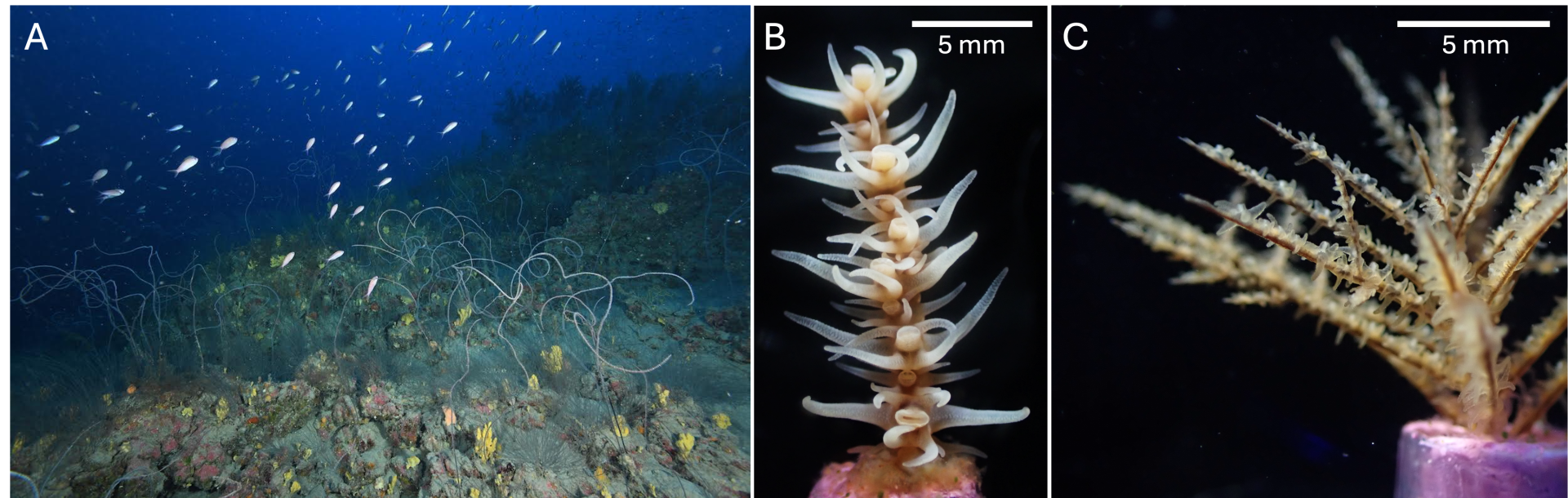
Why are there so many different shapes?
It is remarkable that these sessile organisms have evolved an astonishing diversity of shapes. Some resemble delicate trees, others long whips or elegant fans stretching out into the current. This extraordinary variety raises a fundamental question: Why are there so many different shapes? Could these shapes help the sessile organisms influence their surrounding water in a way that allows them to cope better in their environment?
To answer these questions, a group of scientists around Mathilde Godefroid and Soeren Ahmerkamp, both corresponding authors of the newly published study, ventured into the hidden microscopic world surrounding black corals, or antipatharians. These corals can grow several meters long. “However, the important interactions between the animal and its environment take place at tiny scales, hundreds of times smaller than a grain of sand”, explains Ahmerkamp, worked was previously at the Max Planck Institute in Bremen and is now Group Leader at the IOW. “We looked into these tiny-scale movements to better understand what was going on”, adds Godefroid, who worked with Ahmerkamp at the Max Planck Institute for Marine Microbiology and is now a PostDoc at the Université Libre de Bruxelles in Belgium.
Underwater forests of black corals
Black corals are among the ocean’s most remarkable, and least understood, animals. Found in every ocean, from shallow reefs to the deep-sea, they build complex communities resembling dense underwater forests. These forests provide a habitat for countless other species. “They have a spectacular diversity of body forms and are of major ecological importance for the marine ecosystem”, says Godefroid. “That makes them an ideal model for understanding how shape influences the exchange of materials with the environment.”
Like all corals, black corals form large colonies from a plethora of small individual animals, the polyps. They belong to an ancient group of animals, the cnidarians, that also includes sea anemones and jellyfish. One feature unites many of these animals: Their surfaces are covered with millions of microscopic, hair-like structures. These tiny hairs, called cilia, beat continuously and in perfectly coordinated waves. This way they generate miniature currents immediately around the coral.
Cilia – they beat in sync and serve many different purposes
By making invisible flows visible in great detail, the scientists tracked how oxygen, nutrients, and microscopic particles move between the coral and the surrounding seawater.
To do this, they used an innovative imaging method which, with the aid of microscopic particles acting as tracers, simultaneously visualises water currents and oxygen concentrations. These measurements were accompanied by various measurements for determining metabolic activity. With this approach the team studied fragments of black coral, which originated from reefs off the east coast of Gran Canaria and were kept in aquaria under controlled conditions. Amongst other things, this approach enabled the first direct observation of internal fluid flow in hexacorals using naturally occurring particles and natural ingestion.
“We were very surprised by what we found”, says Godefroid. “Corals of different shapes have developed completely different ways of using these microscopic currents.” For example: Broad, highly branched corals use the cilia to capture and redistribute food particles across their complex surfaces, ensuring that many individual polyps receive a steady supply of nutrients. In contrast, slender, whip-like corals, use cilia for a different purpose: Rather than transporting food, they continuously ventilate the tissues, stirring the surrounding water to deliver oxygen and remove waste products. This microscopic ventilation system allows the coral to keep breathing even when there is little external water movement.
“The story became even more intriguing when we managed to look inside the coral”, adds Ahmerkamp. “By tracking naturally occurring particles, we discovered that cilia are also active within a hidden network of tiny channels connecting neighbouring polyps.” These internal currents transport nutrients and other materials throughout the colony. “They link hundreds of individual animals into a single integrated organism.”
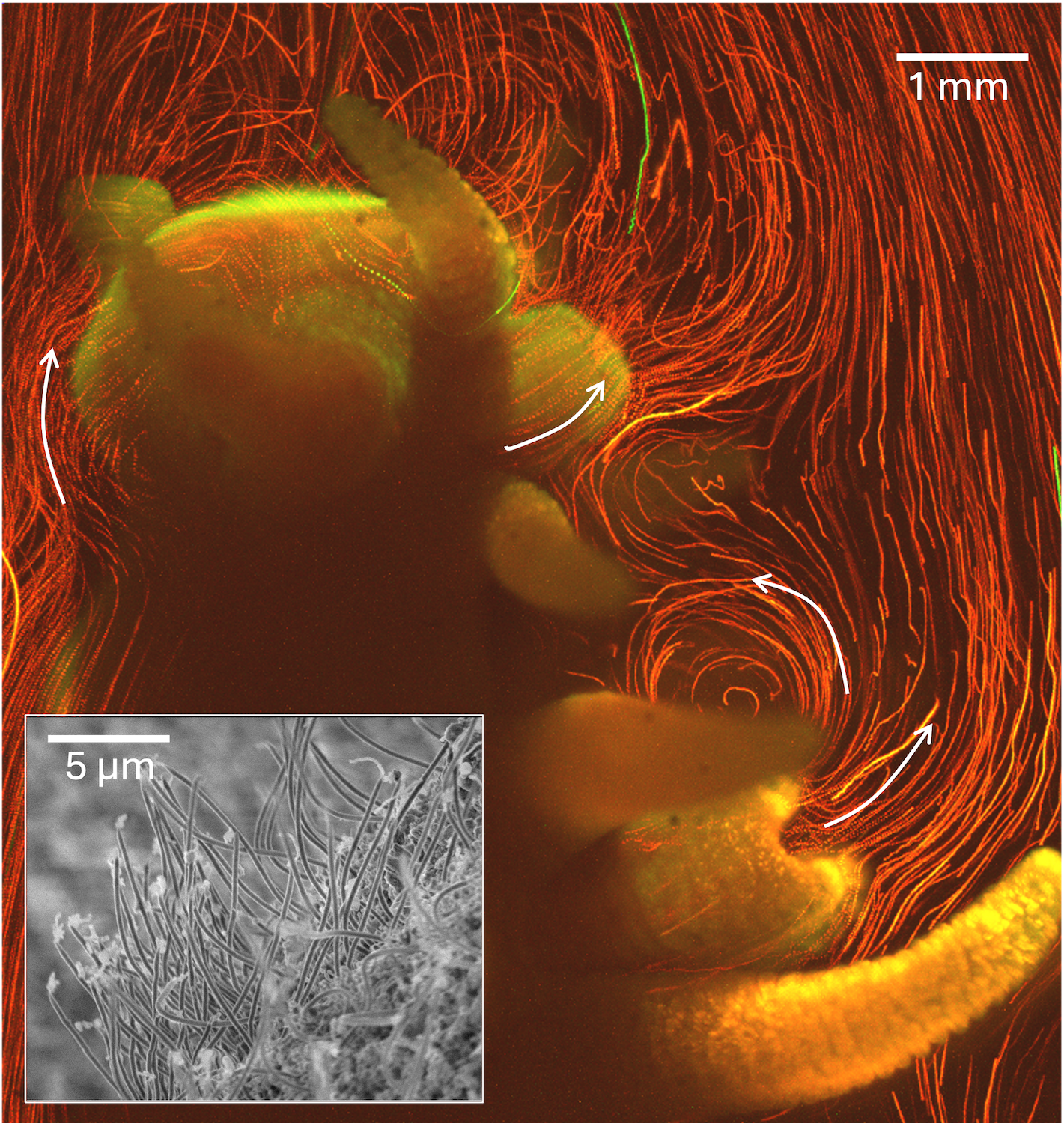
One tool, many functions: A coral’s Swiss Army knife
Taken together, these findings show that the cilia of corals fulfil a remarkable variety of functions; they are, so to speak, nature’s Swiss Army knife. The same tiny structures ventilate tissues, redistribute food, transport materials through hidden internal channels, and ultimately allow corals to engineer the flow of water around and within their own bodies.
These findings suggest that cilia-driven flows represent a fundamental, yet largely overlooked, mechanism underlying the biology of black corals. More broadly, they reveal how microscopic structures can shape the lives of entire organisms, influencing how they feed, breathe, grow, and interact with their environment. “Cilia are found throughout the animal kingdom, from ancient corals to fish, mice, and humans. Our work suggests that these tiny biological engines may have played a much greater role in the evolution and diversification of animal life than previously appreciated”, Ahmerkamp closes.
Original publication
Mathilde Godefroid, Francisco Otero-Ferrer, Michael Wind-Hansen, Lars Behrendt, Ignace Ransquin, Emilio Soler-Onís, Fernando Espino, Sten Littmann, Soeren Ahmerkamp (2026): Ciliary flow and morphology shape mass transport at the surface and within gastrovascular cavities of black corals. Commun Biol 9, 876.
Scientific contact
Dr. Soeren Ahmerkamp | Leibniz-Institute for Baltic Sea Research Warnemünde, Germany
Phone: +49 381 5197 3405 | E-mail: [Bitte aktivieren Sie Javascript]
Dr. Mathilde Godefroid | Max Planck Institute for Marine Microbiology, Bremen, Germany
Department of Organismal Biology, Université Libre de Bruxelles, Brussels, Belgium
Please direct your queries to:
Head of Press & Communications
MPI for Marine Microbiology
Celsiusstr. 1
D-28359 Bremen
Germany
|
Room: |
1345 |
|
Phone: |
