- Press Office
- Press releases
- From the Baltic Sea to Optogenetics
From the Baltic Sea to Optogenetics: The Wondrous Ways of Basic Research
What is optogenetics?
This year’s Nobel Prize in Medicine was awarded to three scientists for developing a method that has revolutionized neuroscience: Optogenetics. It is a technology allowing to control single cells within a tissue using light. Light-sensitive elements, so-called photoreceptors, are introduced into cells, which can then be switched on and off by light. This makes it possible to control individual nerve cells in the brains of living animals.
This way, scientists can for example investigate how nerve cells communicate or how neural activity relates to behaviour. It is also possible to actively manipulate behaviours. For instance, researchers have made fruit flies stay seated, caused mice to twitch their whiskers, and triggered erections in rats. Work is now underway to apply optogenetics therapeutically in humans – for example, to treat vision disorders and hearing loss.
A bacterium as a Nobel Prize building block
Now how is optogenetics related to marine microbiology in Bremen? Indeed, microorganisms in the ocean provided a small building block to the Nobel Prize winning research.
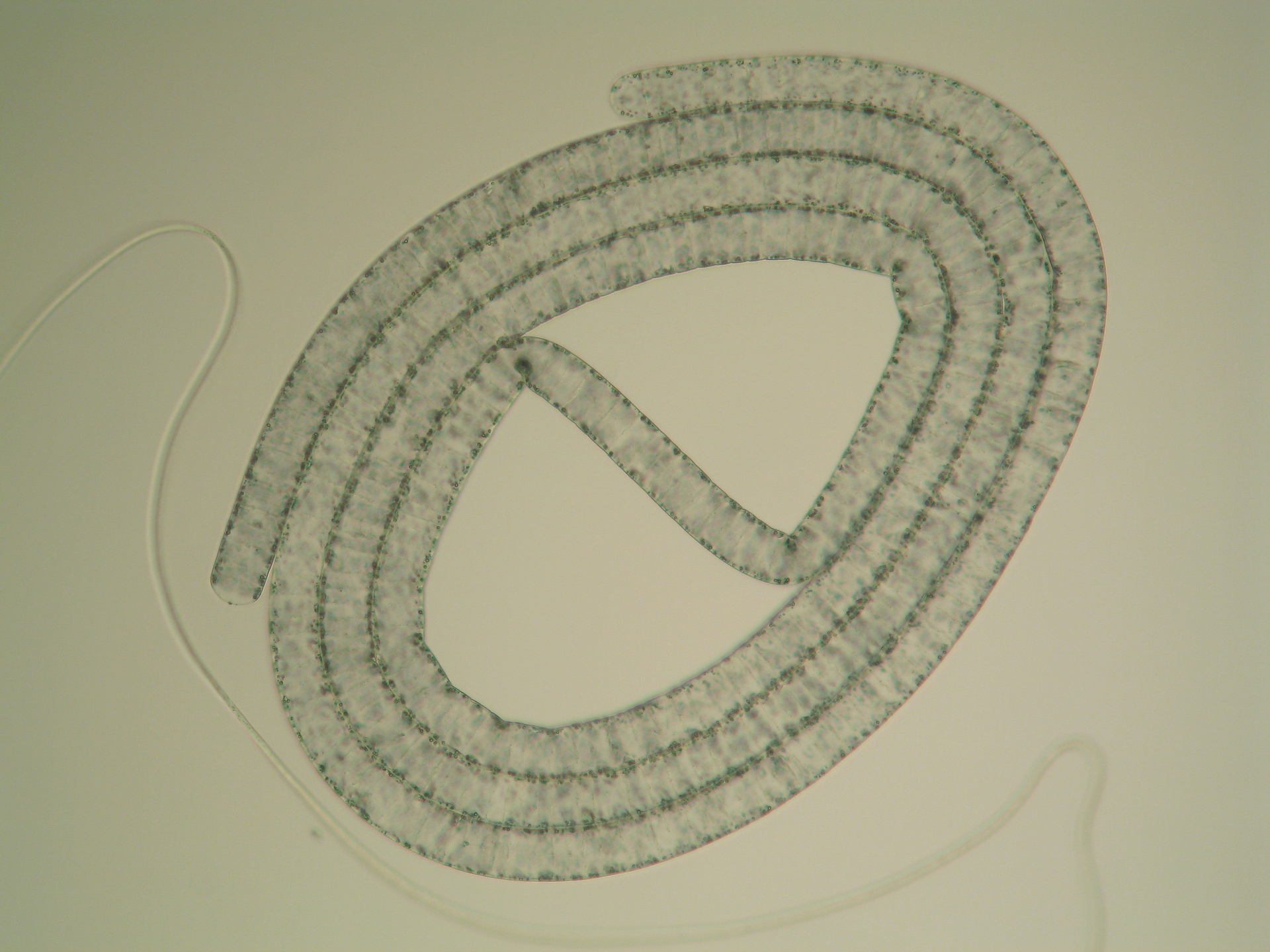
About 20 years ago, scientists from the Max Planck Institute in Bremen collected samples from the muddy seafloor of the Eckernförde Bay to investigate the bacteria therein. One thread-like bacterium in particular caught their attention, which was even visible to the naked eye on close look. This bacterium named Beggiatoa breaks down sulfur compounds on the seafloor and forms distinctive chains of cells. Studying these bacteria was difficult, as they could not be cultured in the lab. “We then came up with the idea of sequencing a single bacterial filament using the then-very-new technique of whole-genome amplification,” explains Marc Mußmann, who was a postdoc at the Max Planck Institute for Marine Microbiology at the time.
Among all the genes that Mußmann and his colleagues found in Beggiatoa, published in 2007 and deposited in an open-access database, there was one that caught the attention of this year’s Nobel Prize laureates. It is a so-called BLUF-AC-Gene, which contains the blueprint for a tiny switch that can be turned on and off with blue light: an enzyme named bPAC. “Back then, we were not particularly interested in that gene, and to this day is is not clear what purpose it serves in the bacteria,” says Mußmann.
Smaller, more sensitive, better: bPAC instead of euPAC
Yet other researchers certainly noticed this gene during routine database searches. Sought and found: A few years after Mußmann’s genome analysis, the team of this year’s Nobel Prize laureate Peter Hegemann published a paperdescribing why the switch enzyme bPAC is an ideal tool for optogenetics. That’s because in order to control nerve cells with light, a gene must first be introduced into them to make them light-sensitive. Hegemanns group initially experimented with a light-switch gene from a protozoan namedEuglena – a single-celled freshwater inhabitant capable of orienting itself toward light.
The bPAC gene from Beggiatoa, however, quickly proved to be far more practical. It is considerably smaller than the previously used euPAC from Euglena. That makes it much easier to insert into nerve cells. Moreover, bPAC can be switched on with much less light – just one-thousandth of the light intensity required by euPAC is sufficient. “These and a few more advantages convinced the scientists to use ‘our’ Beggiatoa gene to equip nerve cells with a light switch,” says Rudolf Amann, in whose research group Mußmann worked. In their publication, Hegemann and his team call bPAC ‘a perfect optogenetic tool for light modulation of cAMP [a signaling molecule] in neuronal cells and tissues’. “And so a little piece of Bremen marine biology found its way into what would later become Nobel Prize-winning research,” Amann says with a smile.
Basic research as the groundwork for major discoveries
The Max Planck Society, which our institute belongs to and where two of this year’s three Nobel laureates in Medicine previously worked, is committed to basic research. Basic research seeks to explain and understand the world we live in, driven by the curiosity and thirst for knowledge of researchers, without aimimg for a specific application.
"Major discoveries in basic research cannot be planned or predicted," emphasizes Amann. "The surprising interplay between optogenetics and marine biology – from the mud of the Baltic Sea to the laboratory of a Nobel laureate – is a wonderful example of this. It shows how a small and inconspicuous piece of knowledge can become a cornerstone of a groundbreaking discovery."
Relevant publications
Mußmann M., Hu F.Z., Richter M., de Beer D., Preisler A., et al. (2007): Insights into the genome of large sulfur bacteria revealed by analysis of single filaments. PLoS Biol 5(9): e230. DOI:10.1371/journal.pbio.0050230
Stierl, M., Stumpf, P., Udwari, D., Gueta, R., Hagedorn, R., Losi, A., Gärtner, W., Petereit, L., Efetova, M., Schwarzel, M., Oertner, T.G., Nagel, G., Hegemann, P. (2011): Light modulation of cellular cAMP by a small bacterial photoactivated adenylyl cyclase, bPAC, of the soil bacterium Beggiatoa. J Biol Chem 2011 Jan 14;286(2):1181-8. DOI: 10.1074/jbc.M110.185496
Kim, T., Folcher, M., Baba, M.D.-E. and Fussenegger, M. (2015), A Synthetic Erectile Optogenetic Stimulator Enabling Blue-Light-Inducible Penile Erection†. Angew. Chem. Int. Ed., 54: 5933-5938. DOI: 10.1002/anie.201412204
Please direct your queries to:
Head of Press & Communications
MPI for Marine Microbiology
Celsiusstr. 1
D-28359 Bremen
Germany
|
Room: |
1345 |
|
Phone: |
