Page path:
- Departments
- Department of Biogeochemistry
- Sulfur and Metal Cycling
Sulfur and Metal Cycling
Metals and sulfur cycle: Combining theory with laboratory observations to understand natural environments
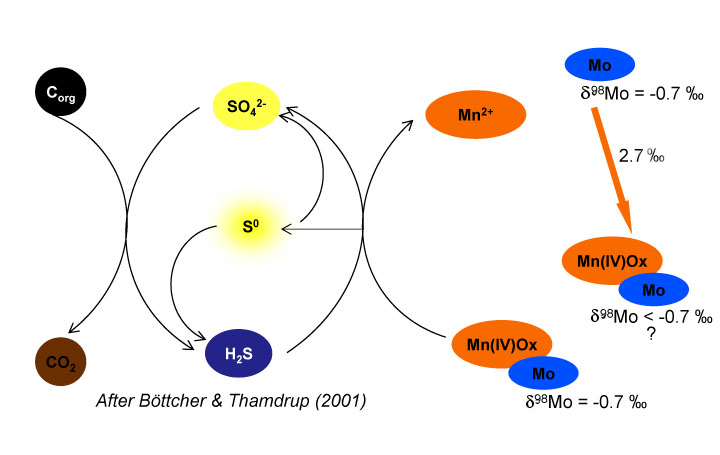
Our understanding of fundamental microbial-mediated reactions is based on observations in the field, laboratory experiments and theoretical approaches. Only a parallel development in these disciplines allows us to gain new insights in microbial cycling of sulfur and metals. Currently, we are focusing our efforts on the microbial controls on S intermediates, stable isotopes of S and O in sulfate, and the connection between sulfur and molybdenum cycling. We explore the mechanics of these processes by designing meaningful laboratory experiments based on theoretical concepts and by establishing new analytical techniques.
Our understanding of fundamental microbial-mediated reactions is based on observations in the field, laboratory experiments and theoretical approaches. Only a parallel development in these disciplines allows us to gain new insights in microbial cycling of sulfur and metals. Currently, we are focusing our efforts on the microbial controls on S intermediates, stable isotopes of S and O in sulfate, and the connection between sulfur and molybdenum cycling. We explore the mechanics of these processes by designing meaningful laboratory experiments based on theoretical concepts and by establishing new analytical techniques.
Zero-valent Sulfur Compounds
• Zero-valent sulfur ontaining compounds (polysulfides, colloidal and solid elemental sulfur and polythionates) are important intermediates of bacterial and chemical sulfide oxidation.
• Inorganic polysulfides are also highly reactive toward organic and inorganic compounds abundant in sediments.
• An important reaction of polysulfides is the reaction with iron(II) sulfide leading to formation of greigite (Fe3S4) and pyrite (FeS2), the most abundant sulfur mineral in marine sediments.
• Inorganic polysulfides are also highly reactive toward organic and inorganic compounds abundant in sediments.
• An important reaction of polysulfides is the reaction with iron(II) sulfide leading to formation of greigite (Fe3S4) and pyrite (FeS2), the most abundant sulfur mineral in marine sediments.

More about the sulfur story? Talk to Alexey Kamyshny or Tim Ferdelman.
Oxygen & Sulfur Isotopes
We are interested in the relationship between oxygen and sulfur isotopes of sulfate because
• Sulfur (S) and oxygen (O) isotopes of sulfate can be used to identify the sulfur and oxygen sources in a natural environment.
• S and O isotopes of sulfate carry information about microbial and abiotic oxidation and reduction pathways in the marine sulfur cycle.
• S and O isotope relationships in experiments with sulfur utilizing microbes species can be used to elucidate the enzymatic pathways used.
Interested in isotopes? Talk to Ben Brunner or Mike Formolo.
• Sulfur (S) and oxygen (O) isotopes of sulfate can be used to identify the sulfur and oxygen sources in a natural environment.
• S and O isotopes of sulfate carry information about microbial and abiotic oxidation and reduction pathways in the marine sulfur cycle.
• S and O isotope relationships in experiments with sulfur utilizing microbes species can be used to elucidate the enzymatic pathways used.
Interested in isotopes? Talk to Ben Brunner or Mike Formolo.
Links Between Sulfur & Molybdenum Cycling
• Molybdenum (Mo) is a bioessential element and plays an important role in the fixation of nitrogen and the detoxification of sulfite.
• Molybdenum is a redox sensitive element and can be used as proxy for paleoenvironments.
• Molybdenum cycling in the modern ocean remains poorly understood.
More about Molybdenum? Talk to Gail Lee Arnold.
• Molybdenum is a redox sensitive element and can be used as proxy for paleoenvironments.
• Molybdenum cycling in the modern ocean remains poorly understood.
More about Molybdenum? Talk to Gail Lee Arnold.