- Abteilungen
- Abteilung Biogeochemie
- Instrumente
Instrumente
In der Biogeochemie wird eine Vielzahl von unterschiedlichen analytischen Methoden benutzt, unter anderem auch radioaktive Tracer und stabile Isotope. Die Methoden werden auf Umweltproben, sowie auf Experimentalproben angewendet. Hier finden Sie eine kurze Beschreibung der Einrichtungen und Geräte der Biogeochemie.
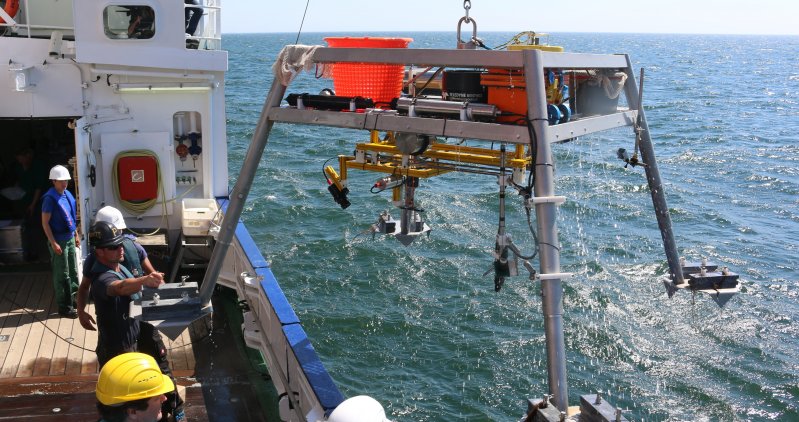
Feldgeräte
- Lance-A-Lot ist ein benthisches Observatorium, welches autonom eine Reihe von komplexen Aufgaben erledigt. Es wurde für ein besseres Verständnis von dynamischen Interaktionen von Porenwasserströmungen, Sedimenttransport und benthonischer Austauschprozesse entwickelt.
- Vier In-situ-Pumpen ermöglichen die In-situ-Filtration von großen Mengen an Wasser. Dabei können ausreichende Mengen an organischer Materie für organische Geochemie, Isotopen-Analyse, Metagenomik und Gentranskription gesammelt werden.
- Das Pump-CTD-System ermöglicht eine kontinuierliche Beprobung der Wassersäule (bis maximal 300 m Tiefe) mit einer hohen Auflösung. Außerdem können größere Mengen von Wasser ohne Kontakt zur Luft (z.B. Sauerstoff) gesammelt werden, um z.B. Inkubationsexperimente von ausgewählten Wassertiefen durchzuführen.
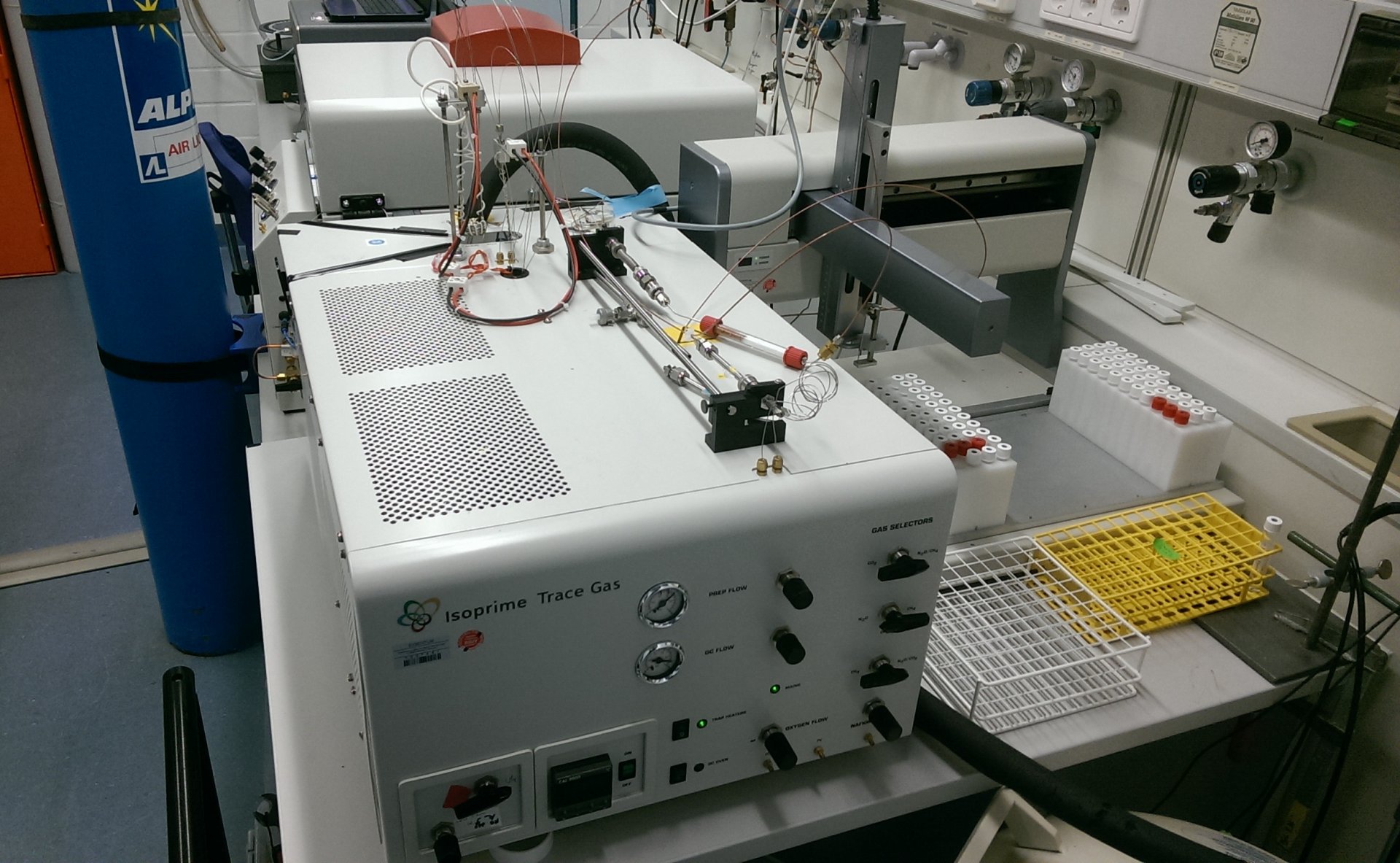
Massenspektrometer
- Delta Plus XP gekoppelt an ein Flash EA 112. Isotopenverhältnis-Massenspektrometer gekoppelt an einen Elementanalysator für die Analyse von δ13C und δ15N von Festproben.
- IsoPrime100 kombiniert mit einem Trace Gas. Multikollektor-Isotopenverhältnis-Massenspektrometer für die Gasanalyse von N2, N2O, NO, O2, CH4 und von Isotopomeren in Wasser- oder Gasproben mit niedrigen (nanomolaren) Konzentrationen.
- Picarro G2201. Cavity-Ring-Down- Spektrometer für die Analyse von Kohlenstoffisotopen, gekoppelt an einen Autosampler (Automate FX) für die doppelte oder einfache δ13C -Analyse von CO2 (DIC) und CH4 in Wasser- oder Gasproben.
- GAM200 InProcess Instrument. Ein Membran-Einlass-Massenspektrometer (MIMS), mit dem wir Online-Echtzeitmessungen von 29&30N2, O2 und Ar mit einer Vielzahl von individuell anpassbaren Einstellungen durchführen können. Andere Anwendungen umfassen beispielsweise die Bestimmung des Isotopenverhältnisses von N2 für N2-Fixierungsexperimente.
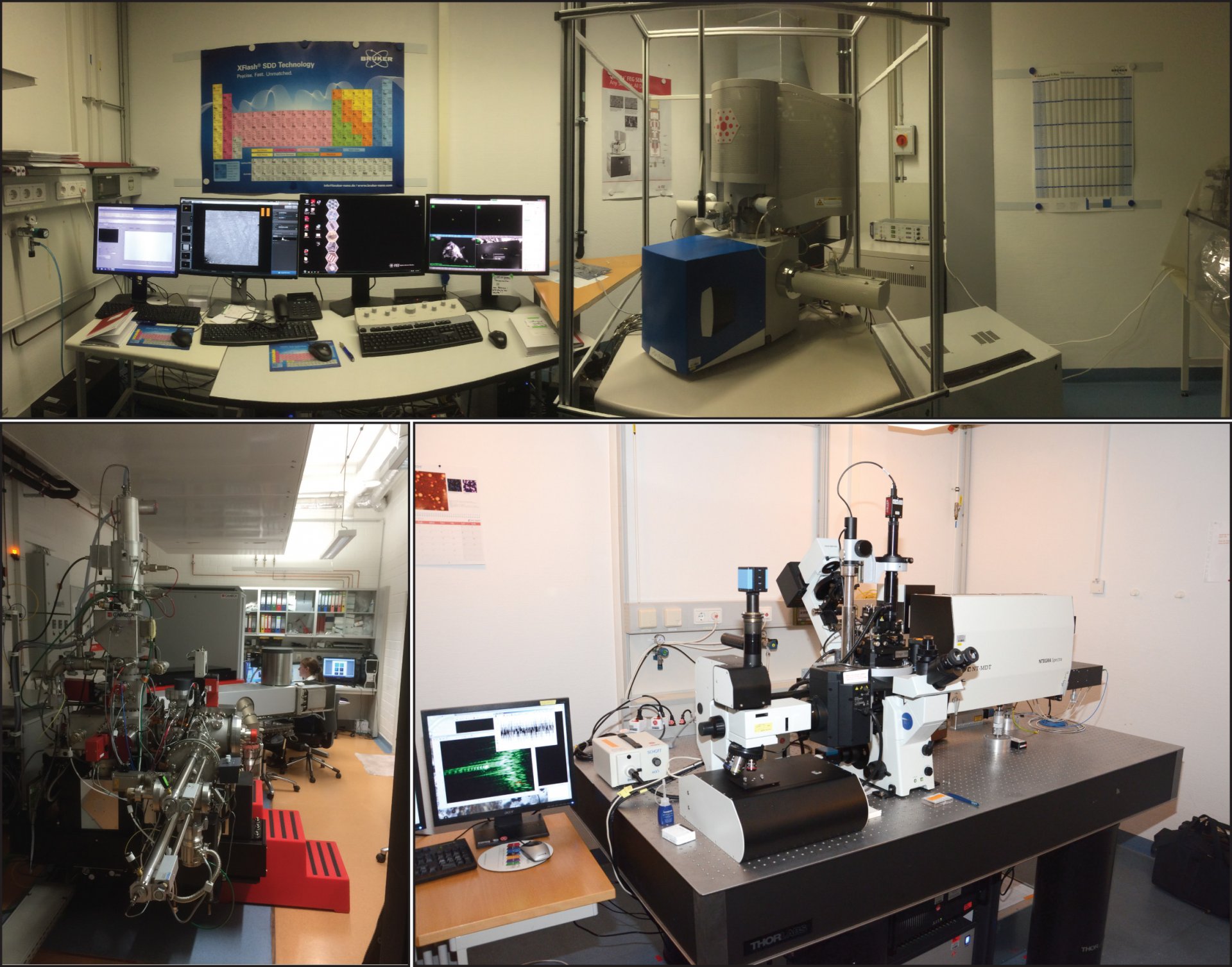
Untersuchung einzelner Zellen
- Lasermikrodissektionsmikroskop (Leica LMD6500) mit 10x - 63x Luftlinsen und Fluoreszenzfiltern (DAPI, Cy3, Cy5, Alexa594). UV-Laser zum Schneiden (Wellenlänge: 355 nm, Pulsfrequenz: 80 Hz, Pulslänge: < 4ns, durchschnittliche Pulsenergie 70 μJ) und zur Visualisierung mit einer CC7000-Farbkamera.
-
Umwelt-Rasterelektronenmikroskop (FEI Quanta 250 FEG) mit einem Transmissionselektronendetektor (STEM), einem Peltier-Kühltisch und einem Bruker-Doppeldetektorsystem für die energiedispersive Röntgenspektrometrie (EDS). Beschleunigungsspannungen zwischen 200 V und 30 kV und einer Auflösung von 1,0 nm im Hochvakuum (30 kV, SE). Zusätzlich ist auf diesem ESEM eine SECOM-Plattform (Delmic) für die korrelative Licht- und Elektronenmikroskopie montiert.
-
Sekundär-Ionen-Massenspektrometer im Nanometerbereich (NanoSIMS 50L, Cameca), eine Ionenmikrosonde, die die SIMS-Analyse mit hoher lateraler Auflösung optimiert. NanoSIMS 50L ist mit einer Cs+ und O-Quelle ausgestattet und kombiniert eine sehr hohe räumliche Auflösung (sub 50 nm) mit einer hohen Massenauflösung. Das Gerät ist mit einer Magnetsteuerung der Kernspinresonanz (NMR) ausgestattet. Das Multi-Collection-System des nanoSIMS 50L ermöglicht die parallele Erfassung von 7 Massen mit Elektronenmultiplikator (EM) oder Faraday-Cups (FC). Link
-
Konfokales Raman-Mikrospektroskop (NTEGRA Spectra, NT-MDT), das sowohl mit einem invertierten Olympus IX71 als auch mit einem aufrechten Mikroskop gekoppelt ist. Ein Diodenlaser (785 nm, 300 mW) und ein Festkörperlaser (532 nm, 50 mW). EMCCD- und CCD-Kamera (Andor Newton) für Raman-Messungen. Hybridsteuerung.
-
Rasterkraftmikroskop (NT-MDT) mit 830 nm IR-Laser für Messungen in flüssiger und Luft-/Gas-Umgebung im einfachen AFM-Modus.
-
Automatisierter kritischer Punkttrockner (Leica EM CPD300) zur Trocknung von biologischen Proben.
- Sputteranlage für die Metallbeschichtung (Au, Pt, Ag) von Proben.