- Presse
- Pressemeldungen
- Manabu Fukui
From Japan to Bremen: How Manabu Fukui found a Scientific Home Abroad
What began as a professional opportunity soon turned into a lifetime experience. When Prof. Dr. Manabu Fukui first arrived in Bremen from a small rural town on Japan’s coast in 1994, he planned only a short research stay. Three decades later, he reflects on how the city and the Max Planck Institute (MPIMM) became a second home — shaping not just his career, but his life.
From Coast to Coast, across Continents
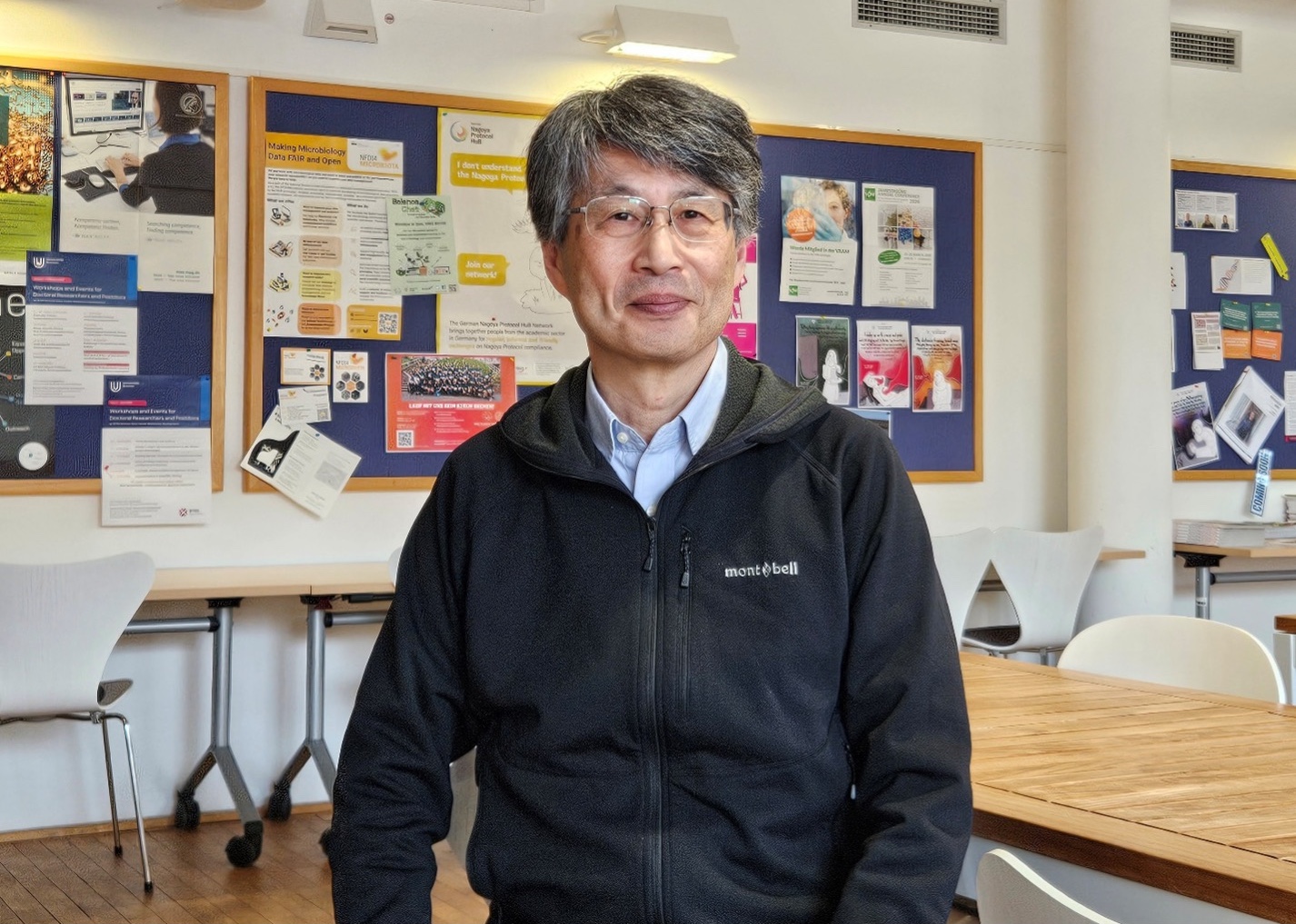
“Upon my first arrival, I definitely did not imagine that the city would become a second home for me”, Fukui recollects. “What was initially planned as a one-off stay, soon turned out to be the beginning of a long and lasting connection with the city.”
At the time, he was a young researcher, shy and quiet by nature. During his early career, he had gotten in touch with the work of Friedrich Widdel and Bo Barker Jørgensen, the founding directors of the Max Planck Institute in Bremen. “Their research themes, mainly sediment microbiology, were very close to my field of interest,” he explains, recalling what ultimately motivated him to apply for a government scholarship and make the journey to Bremen.
Today, Manabu Fukui is no longer the shy young researcher who first arrived in Bremen, but a scientist whose career has been shaped by decades of international collaboration. As he prepares to step into a new phase of his life, this interview becomes an opportunity to look back, not only on his scientific work, but on the personal experiences that made Bremen a second home.
A Warm Welcome in a New World
Fukui’s introduction to Bremen was as unexpected as it was memorable. Days after his arrival, he was invited to tryKohl und Pinkel, a local dish that left him baffled. “I didn't know what Kohl und Pinkel meant, so I looked it up in the dictionary. I learned that Kohl is cabbage, but I still didn't know what Pinkel was. The first taste was quite a shock,” he happily recalls.
Strange tastes and traditions aside, it was the kindness of the people around him that made the day truly memorable. The institute’s secretary Ulrike Tietjen and American researcher Carol Arnosti greeted him in Japanese, a small but meaningful gesture that helped him feel immediately at home. “At the time, I was the only Asian researcher at the institute, and the MPIMM felt like a small, familiar place that differs much from the big, international and interdisciplinary institute that it is now.”
In fact, back then MPIMM in Bremen was not yet housed in its own building but was a tenant in the Bremen Innovation and Technology Center (BITZ), a shared space for startups and research projects. This small, homey environment, with fewer than fifty people, made it easy to get to know colleagues across departments and created a very collaborative atmosphere.
More than Colleagues and Scientific Breakthrough
Friedrich (Fritz) Widdel, then Director of the Institute, became a key mentor. Fukui recalls with fondness the New Year’s Eve he spent at Fritz Widdel’s home in Findorff: “I started chopping onions and celery for the soup, but Fritz had forgotten the meat in the lab refrigerator. He immediately jumped on his bicycle to fetch it. Typical Fritz!” Fukui says, laughing. Together, they watchedDinner for One, laughing over ice cream and cognac — a moment that symbolized the blend of science and friendship.
Scientific Breakthrough and Collaborations
At the Max Planck Institute, Fukui focused on studing Desulfonema, a sulfate-reducing bacterium once considered extremely difficult to culture. Contrary to expectations, Fukui isolated a new species using mud from Germany and Japan, and mastered cutting-edge techniques, including enzyme assays for anaerobic bacteria and fluorescent in-situ hybridization analysis. The collaborative environment at MPIMM, with state-of-the-art equipment and highly skilled colleagues, were crucial to his success. “In Bremen, I could learn from experts just rooms away,” he says. His work led to the discovery of over forty new bacterial species, including Desulfosarcina widdelii, an oil-eating sulfate-reducing bacterium named in honor of his mentor Friedrich Widdel.
Bridging Continents
Beyond his personal works, Fukui also strengthened academic ties between Bremen and Japan, sending students to collaborate at MPIMM and organizing exchange programs. His legacy extends beyond research, fostering international collaboration.
Looking Ahead
Now, as he prepares for a new chapter of life, Fukui looks forward to pursuing interests beyond the laboratory. He plans to enjoy trekking, long walks, and amateur radio, and teaching as a visiting professor in Tokyo. “It’s time to pass the baton”, he says. “I entrust both research and education to the next generation. And if they ever seek my advice, I will be delighted to offer guidance based on my experience.”
